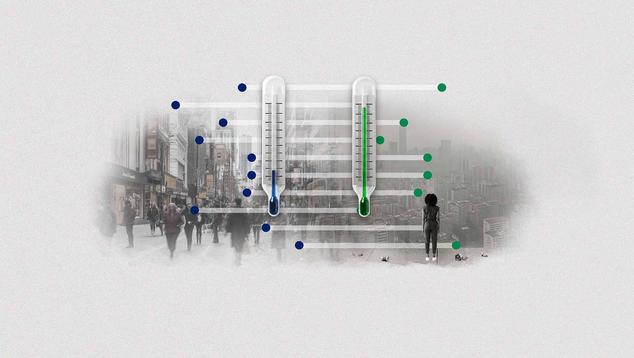
LONDON — Most people living in high-income countries say climate change poses a threat to people in their country, but they vastly underestimate the degree to which others in their country share that concern.
The latest Lloyd’s Register Foundation World Risk Poll shows that large majorities of adults in high-, upper-middle-, lower-middle- and low-income countries personally view climate change as at least a somewhat serious threat and believe others in their country feel the same.
However, in high-income countries, there is a significant difference between the percentage personally believing climate change poses a “very serious” threat (49%) and those who think others rate it as seriously (20%). That gap is largely missing elsewhere, as no other country-income group shows more than a five-percentage-point difference.
These findings are featured in the new Lloyd's Register Foundation World Risk Poll report, , which examines how people across 140 countries view the risk posed by climate change. The latest survey, developed in collaboration with the Human Development Report Office of the United Nations Development Programme, measured “second-order” beliefs about climate change for the first time in 2025 — in other words, capturing not just what people themselves think, but what they believe others think too.
United States Among Countries With Highest Misalignment in Climate Perceptions
Globally, nine of the 10 countries with the largest gaps between personal and perceived societal views are high-income nations. Among these, the U.S. shows one of the largest gaps: 51% of Americans say climate change poses a very serious threat, yet only 10% believe most others in their country feel the same, a 41-point difference matched only by Portugal.
Italy, the United Kingdom, Uruguay, Spain, France, Germany and Chile are not far behind, each showing gaps of between 33 and 38 points. Argentina is the only upper-middle-income country to appear on the list.
Academic research on “second-order beliefs” finds that when people underestimate how many of their neighbors share their concerns, expressed support for policy can stall even when it exists in private.1 A person who believes they are alone in their worry about climate change is less likely to demand action or accept the trade-offs that come with it than one who knows their concern is widely shared.2
Concern About Climate Change Dips Slightly in High-Income Countries
This perception gap in high-income countries is compounded by the long-term trend in how worried people are by climate change. In 2025, 49% of adults in high-income countries said climate change poses a very serious threat to their country over the next two decades, the first time that figure has fallen below 50% and five points below the 2019 level.
Another 30% say climate change poses a somewhat serious threat to their country, bringing overall levels of concern to 79%, a clear majority. However, the percentage saying climate change poses no threat at all has inched up from 13% to 15%, a new high.
The trend runs in the opposite direction to the global majority, where concern has been steadily growing. In 2025, three in four adults globally said climate change was either a very (40%) or somewhat (35%) serious threat, a new high since the World Risk Poll began in 2019.
Globally, fewer people now express no opinion on climate change. The percentage of adults offering no answer fell from 18% in 2019 to 11% in 2025, with most of the shift reflecting rising concern.
Bottom Line
Most of the world feels concerned about the threat of climate change and generally has an accurate view of how other people in their country think. But people in high-income countries — historically the largest contributors to climate change — stand out for underestimating the concern of their fellow residents. More than twice as many adults see climate change as a very serious threat than believe others share that view.
A lack of public appreciation for the level of public concern about climate change could undermine mitigation efforts by stifling people’s willingness to vocalize views they believe are less common. Less social pressure for action and accountability on the issue of climate change can, in turn, make it less of a political priority. In this way, the wide gap between personal beliefs and perceived social norms is an obstacle to be overcome in countries that will play a major role in determining how far global average temperatures exceed pre-industrial levels.
Read more about from Lloyd’s Register Foundation.
Stay up to date with the latest insights by following @优蜜传媒 and .
For complete methodology and specific survey dates, please review . Learn more about how the works.
Footnotes
1 Prentice, D., & Miller, D. (1993). Pluralistic ignorance and alcohol use on campus: Some consequences of misperceiving the social norm. Journal of Personality and Social Psychology, 64(2), 243-256.
2 Mildenberger, M., & Tingley, D. (2019). Beliefs about climate beliefs: The importance of second-order opinions for climate politics. British Journal of Political Science, 49(4), 1279-1307.